Press for the School Food Interventions Toolkit, and state and local action!

From the Harvard Gazette:

While the federal government provides a broad framework, state and local governments have wide latitude in determining the final form of school food programs, according to Bettina Neuefeind, a research fellow at Harvard Law School who collaborates with the Harvard Food Law and Policy Clinic.

Neuefeind said the clinic has worked with Project Bread to create a “school food interventions toolkit” that includes an array of suggestions on how to improve school foods. She discussed just a few of them, including proven ways to “nudge” students into making good food choices, emphasizing food literacy, and paying attention to what are called “competitive foods,” those sold to students outside the national food program, in cafeterias, or at school-related events.

Efforts to improve school food have generated backlash, with some critics complaining that kids throw away the food they don’t like. That, Cooper said, is a problem that’s up to adults to solve by setting rules and guidelines for what kids eat. It hasn’t been that long, she said, since the days when there was no such thing as “kid food,” just food that kids ate with the rest of the family or they went hungry.

“No child has ever died for lack of chocolate milk and chicken nuggets,” Cooper said.

Read the whole story at at http://news.harvard.edu/gazette/story/2015/06/a-dearth-of-nutrition-in-school-lunches/?utm_source=SilverpopMailing&utm_medium=email&utm_campaign=06.12.2015%20%281%29.
Do you wonder how to get better food into public schools?

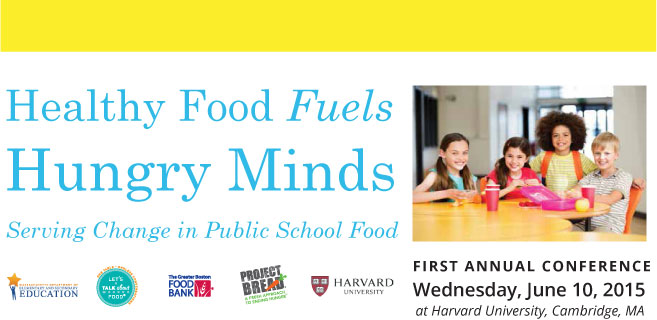
Do you wonder how to get better food into public schools?  Then mark your calendar and head to Harvard University on June 10th for Healthy Food Fuels Hungry Minds: Serving Change in Public School Food.  This day-long conference of panels, presentations, breakout groups and discussions features exciting actors on the school food stage from across the country.  Ann Cooper, Renegade Lunch Lady, will set the tone with her keynote address.  Visit the registration webpage to check out the lineup and to reserve your spot.
The Food Law and Policy Clinic, a teaching clinic of Harvard Law School, is co-sponsoring this conference with Let’s Talk About Food, the Massachusetts State Office of Nutrition and Health, and Harvard University Dining Service’s Food Literacy Project.  FLPC Director Emily Broad Leib and I will speak about the role policy change plays in school food at the local, state, and federal level.
 
Add your voice to the conversation!


Join us for

Healthy Food Fuels Hungry Minds: Serving Change in Public School Food

June 10, 2015, 8:30am-5:00pm, Cambridge, MA

Our first lady touts it; our federal legislation mandates it; our parents champion it; our foodservice professionals strive to deliver it: healthy, fresh food for students in public schools. How can it be so controversial if everyone agrees? Join this first annual conference to understand the current state of childhood nutrition, the nuances of the federal law, the economic, logistical and technical constraints faced by foodservice providers, and creative solutions for improving offerings. This one-day education session will help us forge a collective understanding on the role each of us plays as parents, providers and advocates to effect meaningful change!

Who Should Attend: School Nutrition Directors*, Parents, Policy & Wellness Advocates, Officials and Academics in the areas of Law, Nutrition, Public Health and Education (*Conference attendance earns continuing education credits)

Registration Fee: $35; limited scholarships available

Registration & Full Conference Agenda: https://healthyfoodhungryminds.eventbrite.com

Featured Speakers & Presenters:

  • Ann Cooper, The Ann Cooper Foundation
  • Katie Millet, Massachusetts Office of Nutrition & Health
  • Eric Rimm, Harvard T.H. Chan School of Public Health
  • Emily Broad Leib, Harvard Food Law & Policy Clinic
  • Scott Richardson, Project Bread
  • Kirsten Saenz Tobey, Revolution Foods
  • Catherine D’Amato, Greater Boston Food Bank
  • S. Paul Reville, Harvard Graduate School of Education
  • and more!

Presented by: Let’s Talk About Food, Massachusetts State Office of Nutrition and Health, Harvard Food Law & Policy Clinic, Harvard University Dining Services’ Food Literacy Project


Just Food? Forum on Justice in the Food System

Just Food? Forum on Justice in the Food System, a conference exploring the intersections between social, economic, and environmental justice and the food system, was held March 28-29, 2015.  Learn more and watch talks as they are posted online.  Many talks are already available on video, including one by Pilar Eguez on Quinoa Guilt: Problems and Solutions for Conscientious Consumers, which I found interesting.


Harvard Food+ Symposium

The Harvard Research Symposium on the Nexus of Food, Agriculture, Environment, Health, and Society (or as we call it, the Food+ Symposium) was held on February 27, 2015. The goal of the Symposium was to provide attendees with a sense of the excitement and breadth of the Food+ research underway at Harvard and foster cross-fertilization among researchers.  More than 20 Harvard faculty members from 8 schools and a dozen departments gave 7 minute presentations on their current food-related research. Take a look here to learn more.
Content:

EWG Launches a New Food Scores Calculator


Mark Bittman on the Relationship between Food and Poverty

In his November 11, 2014 article Don’t Ask How to Feed the 9 Billion, Mark Bittman writes: “The difference between you and the hungry is not production levels; it’s money. There are no hungry people with money; there isn’t a shortage of food, nor is there a distribution problem. There is an I-don’t-have-the-land-and-resources-to-produce-my-own-food, nor-can-I-afford-to-buy-food problem.”

I find this a really interesting statement, because of course on some level it is true, and it resonates with my own sensibilities about income and autonomy. That said, it is also true that (a) we have been working on poverty for a long time and are nowhere close to everyone having enough money to afford to eat, or eat well, and (b) if everyone could afford to eat well, we might very well have a production problem (which would be a great thing) to solve next.  So I think there is room for work on both poverty eradication and food systems.


Photo credit: epSos.de, CC License


The Trouble with Antibiotics


Abundance Doesn’t Mean Health

In his recent op-ed in the New York Times, Mark Bittman wrote,

“The budget for food education in the United States pales compared with the marketing budget for junk food, and much of that education is either unconvincing or ignored in the face of the barrage of “fun to eat” ads for the food that is worst for us. (These three charts, gathered in one place by Tom Philpott, pretty much tell the story.) There is, as I’ve complained before, no concerted effort to teach people how to cook, which cannot happen without simultaneously teaching people how to shop for real food.
. . .
In the long run, what’s needed is not a Farm Bill — that tangled mess that’s been stalled in Congress since its expiration in 2012 — but a national food and health policy, one that sets goals first for healthful eating and only then determines how best to produce the food that will allow us to meet those goals. It doesn’t make sense to tell people to eat vegetables and then produce junk; that leads only to bad health in the face of evident abundance. What’s so great about that?”

Read more >>


Photo credit: KateMonkey. CC License.